Location gives meaning
The same move near a range boundary and in the middle of an accepted area can support different hypotheses.
AUTHOR'S SYSTEM · GOLD MARKET INTELLIGENCE
XAU AMT PRO brings auction structure, volume profile and GC order flow into one analytical workflow. Follow the market context, see the planned levels and understand the status of every scenario.
CONTEXT BEFORE THE SETUP
A price move means more when its context is clear. XAU AMT PRO identifies balance, trend and transition, assesses acceptance or rejection around significant levels and checks the available flow of trades before a scenario reaches confirmation.
Price rotates within a range. The system watches its edges, rejection and a return into the established area.
THE XAU AMT PRO WORKFLOW
AMT gives the analysis its sequence: understand the auction, locate price, recognise a model and test the current evidence. The entry plan follows that context, while each scenario keeps its own status and history.
Assess whether the auction is rotating in balance, moving directionally or changing character. The response to a level is read within that context, using closed candles on the timeframes relevant to the selected mode.
Locate price within observed structure and, when available, the current volume profile: POC and the value-area boundaries VAH and VAL. GC references provide futures context; XAUUSD keeps its own price basis for entries and risk.
Look for a recognised model, such as rejection and return or acceptance and retest. It can create a candidate with planned levels and pending conditions. SWING requires a closed H4 model before a corresponding M15 entry can qualify.
Assess GC Delta, directional volume and CVD under the selected policy, alongside fresh data, the current trigger and level checks. Directional evidence must fit the scenario; an interesting location alone does not complete confirmation.
Relate the planned entry to a structural stop with an ATR buffer and up to three target levels. Required checks determine confirmation. Preserve the original scenario, notify the event and observe subsequent price outcomes separately from actual execution.
UNDERSTAND THE METHOD
AMT provides a way to read the auction: where price is accepted, where it is rejected and whether the market is rotating or discovering a new area. XAU AMT PRO turns selected elements of that framework into a traceable analytical workflow.
Auction Market Theory is an established analytical framework. Buyers and sellers meet through transactions as price explores different levels. Some areas attract sustained two-way trade; others are visited briefly before price moves away. The relationship between price, participation and location gives a move its context.
Balance describes rotation within an accepted area. Directional price discovery explores beyond it. Volume Profile helps describe activity by price through traded volume; Market Profile describes the auction using time at price. These are related tools with different measurements. The profile references used by this system are volume-based and complement the observed price structure.
The same move near a range boundary and in the middle of an accepted area can support different hypotheses.
An excursion matters through what follows: continued trade outside an area, a hold, or a return inside. A single wick does not establish the outcome.
Accepted areas develop. A scenario remains conditional on current structure, fresh evidence and the checks required by its mode.
Here, value describes a reference area associated with sustained trading activity. Price may explore beyond that area.
Context distinguishes rotation, attempted breakout and directional discovery.
The volume Point of Control is the price level with the greatest traded volume in the selected profile.
An observed reference when current profile data is available, rather than an inevitable destination.
Value Area High and Low mark the boundaries of the value area in the selected profile.
They help locate price relative to the profile; they do not guarantee support or resistance.
Evidence of sustained trade beyond a reference area, with price holding rather than immediately returning.
A continuation hypothesis still needs the relevant closed model, trigger and confirmation checks.
A brief exploration followed by a return away from the tested prices suggests rejection.
A return inside an area can support a reversal candidate when its structure and checks agree.
Price revisits a previously crossed or tested reference, allowing its response to be observed.
The current closed trigger is checked; touching a level alone does not complete an entry.
Aggressor buy volume minus aggressor sell volume over the chosen interval.
Directional trade-flow evidence. It does not count distinct buyers or identify a particular institution.
Cumulative Delta adds successive Delta values over a defined period, subject to its reset convention.
Changes are assessed using a compatible baseline; missing history or a reset must be considered.
Read the distribution of activity, the position of price and its response together. Each state asks a different analytical question.
Activity concentrates around an accepted area. Price rotates between its edges, while the central POC marks the profile’s greatest concentration.
WHAT THE SYSTEM ASSESSESAt a boundary, the system examines rejection or a return into value. A location alone does not establish an entry.
Directional discovery changes the location of trade. In this example, price advances and a higher area begins to attract activity.
WHAT THE SYSTEM ASSESSESThe system examines acceptance, a pullback and a coherent continuation model. Direction still requires the applicable trigger and checks.
The earlier distribution loses clarity. An attempted break and a return create competing responses rather than a stable new auction.
WHAT THE SYSTEM ASSESSESThe system reassesses the context and waits when the model or evidence is incomplete. A fresh movement is not automatically a confirmed signal.
Conceptual illustrations. No current quotes, measured market volume or active trading signals.
These are educational paths through AMT, not current trade recommendations. The illustration has no live prices or predicted profit.
Rejection
Price explores beyond the upper boundary but fails to establish sustained acceptance there.
Identify an established upper value boundary and the surrounding structure before judging the new movement.
The system examines a rejection scenario; the subsequent path of price remains open.
A return inside value does not guarantee a move to POC or to the opposite boundary.
The general framework is broader than any algorithm. This is the actual sequence used to build and assess the system’s scenarios.
Use XAUUSD closed candles and current GC evidence. Freshness, chronological consistency and gaps in the required candle history affect readiness.
Evaluate balance, trend or transition on the relevant timeframes. Each mode has its own horizon, so the same local movement can have a different role.
Check recognised closed-candle structures such as rejection/reclaim or acceptance/retest. Without a recognised setup, analysis waits. SWING requires a closed H4 model before a corresponding M15 entry can qualify.
Form the planned entry and a stop beyond relevant structure with an ATR-based buffer: M15 for SCALP, H1 for INTRADAY and H4 for SWING. Early target projections remain preliminary; confirmation requires suitable structural targets.
Check the current trigger, levels, stop risk, targets and fresh order-flow evidence. Mandatory GC components depend on the selected policy; CVD is mandatory under the strict policy. Incomplete candidates remain visible with pending conditions.
Record confirmed entries separately and retain scenario identity. Automatic Telegram events follow. Candidate observations begin after delivery and an observed planned entry, using subsequent closed M1 candles; gaps or uncertain sequences retain an uncertain outcome.
AMT is an established framework. XAU AMT PRO implements selected principles through explicit models and checks. The educational examples explain the framework; the workflow above describes the system’s formal conditions.
GC provides futures-volume context and confirmation evidence. XAUUSD retains its own entry and risk levels; futures references are not mechanically converted into CFD prices. Fresh, compatible data matters.
Three target fields describe a plan. An observed TP event records price behaviour, not a broker fill or net profit. Candidate outcomes remain separate from confirmed entries and are never promoted retrospectively.
THREE PERSPECTIVES ON PRICE
Price Action, SMC and Auction Market Theory can overlap. This is our comparison of their common emphases, not a universal ranking of trading methods.
Comparison table. On smaller screens, scroll horizontally to read all three approaches.
| Price Action | Smart Money Concepts (SMC) | AMT |
|---|---|---|
| Starting point Candles, price swings and responses at levels. | Starting point Market structure and hypotheses about liquidity. | Starting point Balance, price discovery, acceptance and rejection. |
| Reference points Swing highs and lows, support, resistance and retests. | Reference points BOS / CHoCH, order blocks and fair value gaps (FVG). | Reference points Value and volume profiles: POC, VAH and VAL. |
| Reading the evidence Describes visible price behaviour. A candle does not identify its participants. | Reading the evidence Liquidity narratives remain hypotheses; a pattern does not prove institutional intent. | Reading the evidence Volume distribution adds context; Delta does not identify a participant’s intentions. |
| Shared tools Can combine higher timeframes, volume, risk rules and automation. | Shared tools Can combine higher timeframes, volume, risk rules and automation. | Shared tools Can combine higher timeframes, volume, risk rules and automation. |
Our advantages come from the implementation and the working process, rather than the name of a method.
Data freshness and the selected GC confirmation policy govern how futures volume, Delta and available CVD contribute to a scenario. Missing evidence stays visible.
Formal data checks support the analysis. SWING requires a closed H4 model followed by an aligned M15 trigger; a plausible chart alone does not complete that sequence.
Candidates and confirmed signals have separate statuses and histories. Automatic notifications carry their updates; they do not represent automated order fills.
GC futures and XAUUSD are different instruments. Profitability needs forward statistics and trading costs; this comparison does not establish a performance advantage.
THREE HORIZONS
Short-term scenarios with a current closed trigger, contextual levels and order-flow checks.
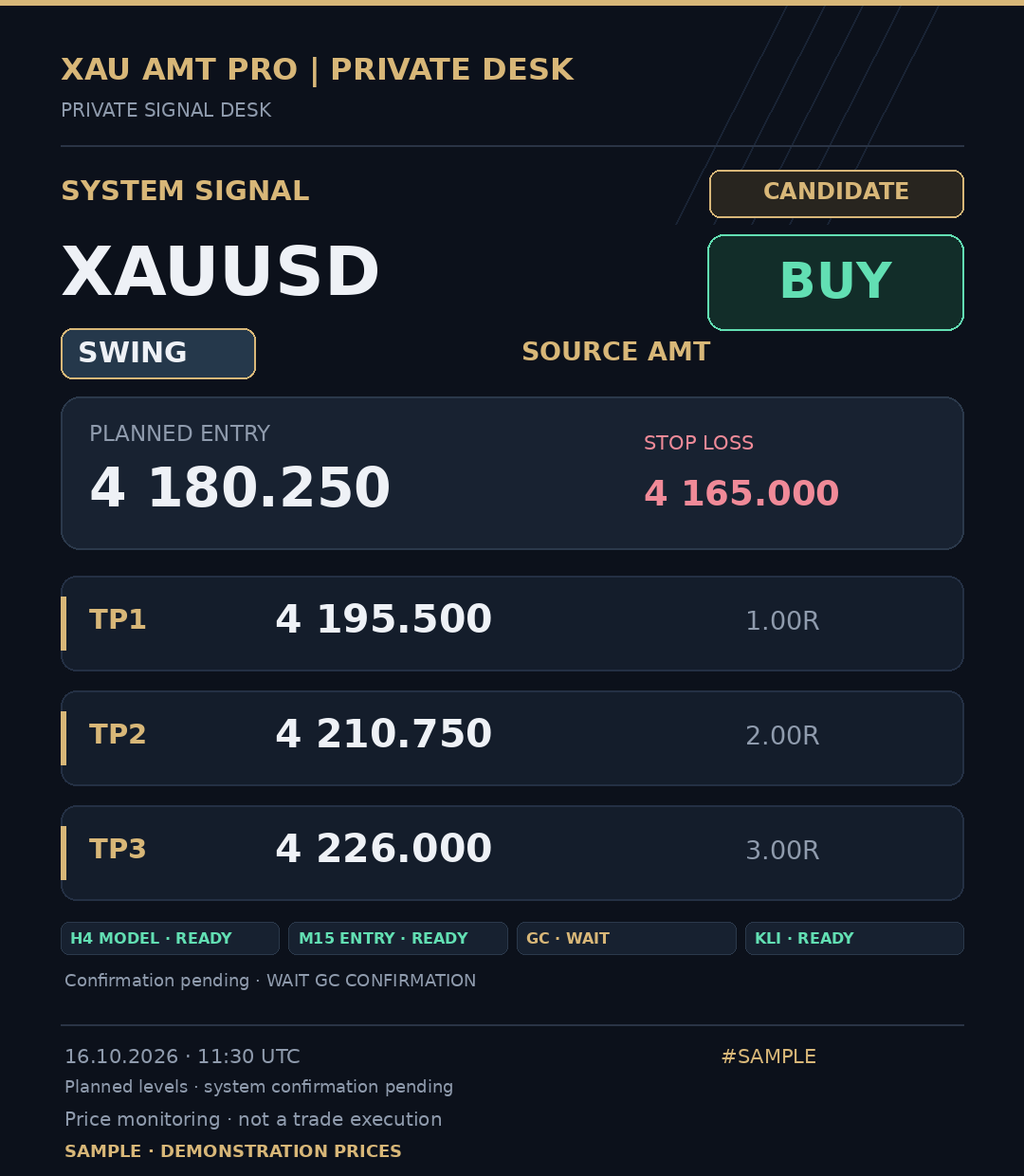
Card-format demonstration. The displayed price levels are illustrative.
SYSTEM SIGNALS
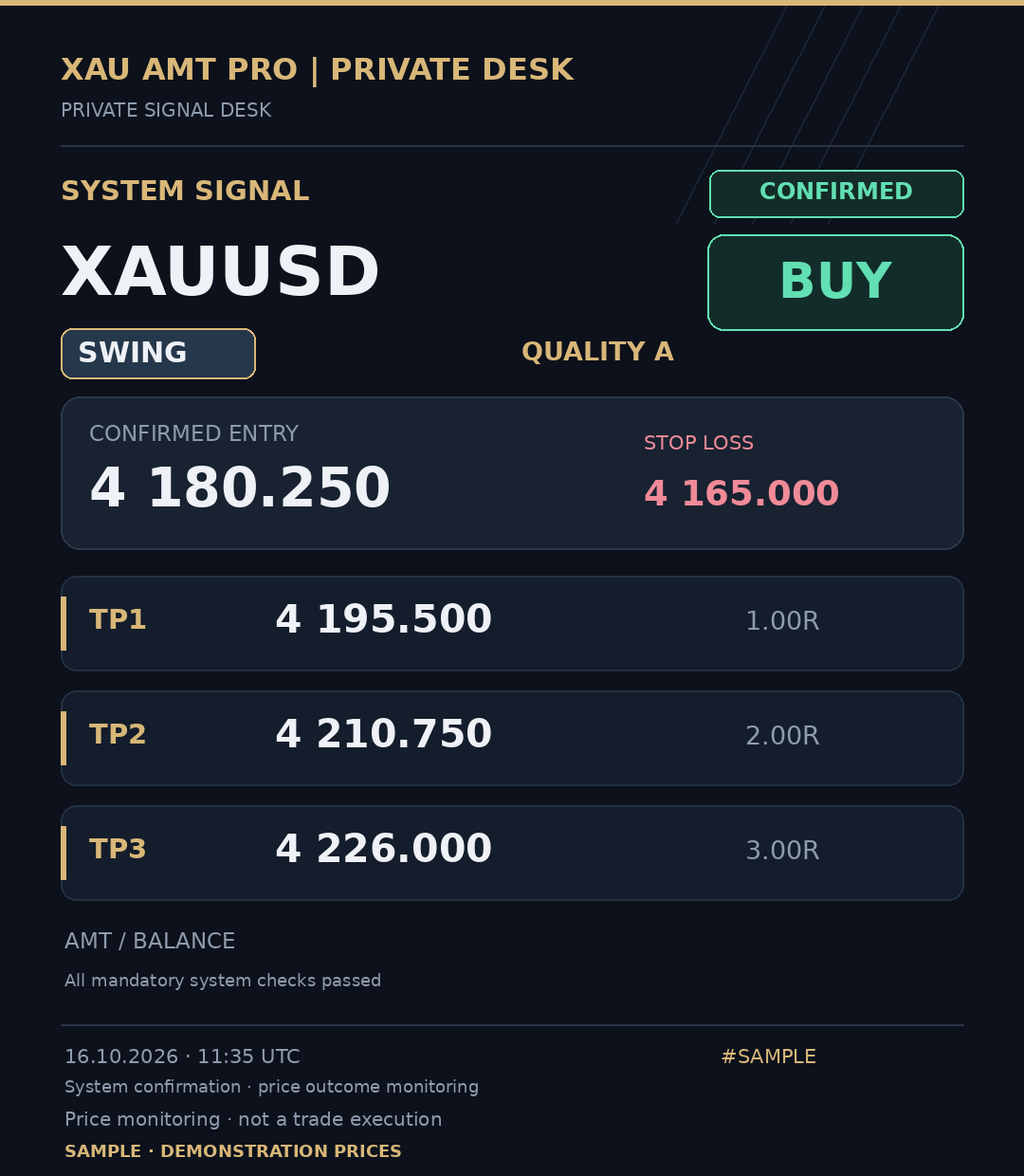
Candidates, confirmed entries and observed target events carry different meanings. The card keeps the scenario readable as its status develops.
SYSTEM SIGNAL · CANDIDATE — a working trading scenario with a preliminary plan. When entry, SL and TP levels are available, a trader can choose to trade the candidate while some system checks remain pending. This is the trader’s own entry decision; system confirmation is a separate status.
BUILT FOR A CONSISTENT WORKFLOW
Observe the auction. Follow the process.
Auction structure, relevant levels and current flow checks contribute to the same analytical process.
A candidate shows what is ready and what is still pending, including unavailable or outdated data.
The original plan and time remain in the history. A later coherent entry can be linked to its scenario without rewriting the past.
During market sessions, a running system monitors fresh data and sends events automatically. Actual delivery depends on connectivity and the messaging service.
THE PROJECT
XAU AMT PRO was created to make gold analysis a consistent, reviewable process: from the first market idea to a recorded system event. The project connects AMT context, price structure and available volume evidence while preserving the original plan and its status. Its development focuses on how new scenarios behave after they form, using the information available at each stage.
The starting point was a practical analytical workflow: identify balance or directional movement, locate meaningful areas and read the response of price. Those criteria became a common method so that an interesting movement could be assessed within its context and followed as a scenario.
SCALP, INTRADAY and SWING became distinct modes with their own context, model and structural-stop framework. Volume-profile references and GC Delta, volume and CVD checks add evidence when the required data is current. SWING begins with a closed H4 model and a corresponding M15 entry check.
A candidate is a system signal at the scenario stage. Its planned levels and pending checks remain visible. Confirmation is recorded as a separate event after the applicable conditions pass, allowing the user to distinguish an active hypothesis, a waiting state and a confirmed entry.
Each scenario keeps its original levels and confirmation history. This allows the initial idea, the checks applied and subsequent price events to be reviewed together: targets reached, invalidation or an uncertain sequence. Price observations and actual execution are recorded separately, preserving the meaning of each event.
A running system can monitor around the clock during the trading week while the market is open and fresh data is available. Telegram events are sent automatically when conditions occur. Ongoing evaluation follows newly formed scenarios and actual subsequent observations; it does not imply a fixed flow of signals.
XAU AMT PRO ACCESS
Choose the access period that fits your workflow. Every plan includes the same system features.
€79 / month
THE COMPLETE SYSTEM
€71.10 / month
THE COMPLETE SYSTEM
€67.15 / month
THE COMPLETE SYSTEM
€59.25 / month
THE COMPLETE SYSTEM
One payment for your selected term. No automatic recurring charges.
Payment services are being connected. You can create an account and choose a plan now.
It is an independently developed analytical system for gold. AMT, auction structure, volume-profile levels and GC order-flow checks support a workflow covering scenarios, confirmations and subsequent observations.
With a complete preliminary entry, SL and TP plan, a trader can choose to trade a candidate, taking account of its pending checks and risk. A confirmed signal is a separate event after the applicable system conditions pass. Reaching a planned target does not change the candidate’s original status.
Volume-profile levels such as POC, VAH and VAL describe significant areas of traded volume. Delta, directional volume and CVD help assess the flow of trades in GC. These data are used when available and current; futures prices are not mechanically substituted for XAUUSD entry levels.
A model must first be established on closed H4 data. The system then checks a corresponding M15 entry, together with the required level, data-quality and order-flow conditions.
Monitoring can run around the clock during the trading week while the system is operating and receiving fresh data. Alerts are generated when events and conditions occur. Market closures, missing data and delivery delays affect availability; there is no fixed number of signals.
It records an observed price level. It is not a broker execution report and does not account for an individual entry, spread, commission or slippage. Ambiguous candle sequences and missing data remain identified as uncertain.
Account registration is available. Plans start at €79 for one month, with fixed-term discounts. Card, bank transfer and cryptocurrency payments will open after the relevant services are configured. No payment is currently taken.
XAU AMT PRO supplies analysis and notifications; it does not place orders. The user makes trading and execution decisions. Telegram notifications are currently in English, independently of the language selected for this website.
XAU AMT PRO